Q&A Everyday: Being a “yes-man” means you’re not innovating and you’re not adding any value to the conversation

Throughout our work lives there will be ups and downs, but invariably there will also be routine tasks or process that you follow on a daily, weekly, monthly or annual basis. And while there’s nothing wrong with a little repetition down a well-beaten path – where’s the adventure or innovation in that?

So in this post, we’re going to throw out the map (if you will) and see what happens when we question things and look for solutions in new ways.

Don’t just go with the flow

As mentioned in the title, if you’re not innovating then you’re not adding value. Every hear the phrase, “it’s so easy even a monkey could do it.” Yeah, it’s like that. But you and I both know we’re smarter than those hairy banana-peelers down at the zoo… so let’s start acting like it. First step: Question Everything!

Although I do say that with a little of asterisk disclaimer overhead – and while I don’t want to completely derail from the topic at hand – I’ll just say this: Question everything, but be smart about it.

I think we’ve all been in a meeting where that certain someone has to pick apart every little detail down to the atom that created it. Don’t be that person.

Question Everything

There is a big difference between annoying your co-workers and colleagues to the point of them needing midday cocktails versus being the one at the table interested in smart innovating. So please remember the asterisk every time you hear me say “question everything”.
Okay now back to the main event. Hopefully as this idea has started to roll around in your head there are things you’ve started to identify as “the good ol’ ways”. Those are the things we’re after:
– processes for weekly/monthly annual reports that haven’t changed in years
– or ways information is presented to/from vendors that haven’t ever had an upgrade

And probably one of the bigger black-holes in all of this are the annual expenditures that just “renew” magically without anyone actually asking, “Why are we paying $___ for ___?”

Take a marketing budget for example… unless Don Draper is leading your creative time, any money earmarked for “traditional media” aka billboards, direct mail, print ads, etc. needs to be seriously reconsidered and allocated into the digital ages of web, mobile, social and search. (Sorry Peggy.)

The challenges of doing something different.

Well the good news is that everyone loves change and embraces it wholeheartedly. So getting your company to try something completely new should be no problem. (“Oh hello Irony, I didn’t see you come in…”)

Obviously that is complete fiction, although it would be pretty awesome if it was true, but the reality is you’ll most likely have a bumpy road ahead if you try to detour your workmates and/or senior leaders away from the comfortable routine they’re used to. But it’s important to try, and if you feel yourself in need of some inspiration, remember this quote:

We've always done it this way

Just keep reminding yourself of that – and in the meantime – here are two additional tips to help get your “new ways of doing things” off the ground.

Create a Plan for a Test Case
People are much more open to change when they thing they can get out of it. “Money Back Guarantee” or “Free Trial Offer” – you know the drill. So follow suit and create a plan for a test/demo/beta (whatever floats your boat) and frame up your idea more as a “What if we…?” to get more buy-in.

Find an Ally
Just as friends are important in daily life, allies are important in business. Find someone (there has to be some body) who will support your idea. And (bonus!) once you tell them about it, they may have ideas for improvement. So now, not only do you have better innovative solution but your ally is also more invested because now they have a stake it in. Boom.

So let’s wrap this up and get you out there innovating… just remember the following:
– Question Everything*
– (*Don’t be annoying)
– Change is Hard
– Develop a Test-Case
– Find an Ally

Good Luck and Happy Innovating!

Check Your Watch: The challenges of executing a marketing promotion across different time zones

Most everyone enjoys watching sports as a pastime and why not? Seeing a group of people chase, throw, catch, hit or kick a ball around is generally considered a good time. But what happens when all this action is going on across different time zones? Where do you set up a home base – or should you? In this post we’ll look at how to tackle (sorry, had to use at least one sports puns) marketing a sporting event promotion successfully from sea to shining sea.

One of the biggest mistakes I’ve seen is when the marketing team decides that wherever they are is the home base, so everything is planned and designed through that lens. Which is an understandable point of view, but let’s try to step back a bit and consider a few things before planting our flag in Mt. It’s All About Me.

Also for the purposes of this exercise, let’s say the Marketing Team is located in Portland, OR so we have a point of reference. But feel free to ad-libs style the questions below and swap in your city so it’s a more useful evaluation tool.

• Is Portland also where there’s a large customer base? Where the corporate office is located does not always equal a fruitful customer base so be careful with this one.
•• Ask for sales numbers at all of your companies locations (if you have brick and mortar storefronts) or pull analytics from social media and web to see if there are any concentration areas where a lot of your business is coming from. In the end I would still not recommend picking one singular place as a focal point, but if you do find there are some ‘hot spots’ across the country maybe consider adding something extra to the promotion in those areas.

usa50

• Are you working with an agency? If yes, then make sure you ask them to consider point #1. An agency could be located anywhere (near or far) from the corporate office much less any customer ‘hot spots’. Be sure you ask them about this and formulate a plan that will bring about the most success for the campaign, regardless of where the marketers are located.

• Getting back to the team in Portland (who’s also be rocking the Pacific Time Zone) keep in mind that you should be publicizing the times of the events in the most common way they are shared. Which not necessarily what makes sense for your own geography.
•• For example: NFL games. If you’re working on anything football related, you’ll notice that every game on the schedules is posted in Eastern Time. So if you’re going to create any collateral, I recommend doing the same. It’s one consistent message for your customers and if you provide any links back to NFL.com in any of your social campaigning, your customers will see information consistent with what you have shared with them regarding your promotion.

football
Now that we’ve covered all of that, and still using football as an example, another big miss for brick and mortar folks is navigating the ups and downs of opening early or staying open late. Because as much as we’d all like to have one national campaign, let’s be real, that’s not going to happen. So keep these things on your radar:

• To use Sunday Football as an example, the first games start at 1pm Eastern which is 10am Pacific. You think, great! But wait.
•• What time do your West Coast locations open normally on Sundays? If it’s not before 10am, can they?
•• Do you have the staffing and budget to support those extra hours?
•• Also how will you let your customers know that you are opening early so you get the business to support and validate opening early.

• Now let’s talk about the last game on Sunday’s which starts at 8:30pm Eastern, 5:30pm Pacific. This one is great for West but for anyone in the East, those games can go on until 11pm or later, so let’s ask a variation of the same questions from above.
•• Do you normally stay open that late? Do you want to?
•• Do you have the staff or budget in place to support it?
•• And most importantly, does your promotion even make sense for a game that runs late into a Sunday evening. For most of America that’s a “school night” and we all have to get up and go to work the next day. Does what you’re asking your customers to do justify them staying out later then they normally would? What’s the value proposition and reason for them to give up on some shut-eye to stay engaged with your brand?

Overall the biggest take-away is this: plan strategically and thoughtfully.

Think about where your customers are, what they want and what makes the most sense for them dependant upon day of the week, time of day and what your promotion is offering. If it makes sense, which I think it does, plot out a marketing plan per time zone.

And don’t be afraid to ask your customers for their feedback too! We all know how people love to share their opinion (yay interwebs) so ask them. The answers might surprise you and offer up alternatives or add-on’s to the promotion that you hadn’t considered before.

Hope this has been helpful and please share any of your own marketing experiences in the comments! #GameOn


Thank you worldatlas.com for the USA map outline!

Office Dilemma: Someone stole your work! Now what?

To kick things off, let’s just call it how it is:
• It sucks when someone steals your work
• Sadly it probably happens to someone, somewhere everyday


Oh corporate America, definitely not known for being a level playing field and everyone giving each other high-fives and handshakes every time a match is over. So what do you do when someone takes your work/project/data and passes it off as their own? I don’t think anyone has all the answers, but here are a few tips to help navigate what is possibly one of work-life’s most sticky situations…

sound-off1. Stay out of the mud.
As tempting as it may be, don’t retaliate and don’t act in the moment. Emotions will no doubt be high when you find out what has happened, but sending an email/voicemail/text full of vocabulary usually reserved for Eminem lyrics is not the way to go.

It will only reflect badly on you, no matter how justified you may feel in sending it, and once it’s out there you can’t take it back.

2. Clear the air.
So even though a verbal smack-down or trip to the thunder dome are off the table (and typically frowned upon by HR) you can and do need to stick up for yourself.

Once the dust has settled, decided on a plan of action. Depending on your position and the position of the person taking liberties with your stuff, figure out what next steps would be most effective in getting the situation resolved.

Maybe it is an email, written thoughtfully, and outlining what has happened from your POV? Maybe it’s calling a meeting with upper management and the person involved? Whatever the next step is, make sure you only speak from what you know and what you have in writing. Making accusations or throwing out assumptions will only discredit you.

3. Proceed with caution.
Immediately following the points above about clearing the air, if you do want to meet with the other person make sure there is a 3rd party (aka a mediator) in the room. Having someone else there will limit any he said she said nonsense, should it come to that, and at this point you want to take every precaution.

After you get through all of that and once the situation has been resolved – or even if it’s not – then what? It’s hard to get that ‘team spirit’ back after someone has pilfered your goods, but life goes on.

My advice is to look at it this way:
6-months

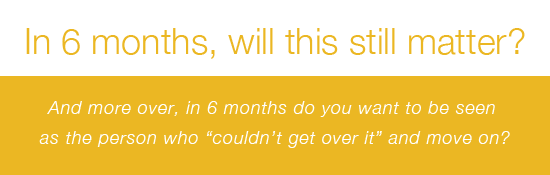
Your career and personal happiness are much more important than whatever happened and in the end the goal should be to take the high road and be a team player that others enjoy working with. So don’t let someone else’s lack of professionalism and immaturity drag you down.

Or as our friend Eminem likes to say, “You only get one shot, do not miss your chance to blow. This opportunity comes once in a lifetime yo.”

Yo, indeed.

3 Tips For Creating A Winning Presentation

Winning PresentationMaybe it’s because I come from a graphic design background, but the importance of having a solid deck (powerpoint presentation) is not lost on me. And when I say ‘solid’, I’m not talking about all of the fancy facts and figures procured from the insights or finance department.

I’m talking about the basics like: fonts, page layout and presentation size. It’s unbelievable how many presentations I’ve seen from agencies, sales people, etc. that forget (or just don’t know) these 3 basic rules.

1. Fonts
While it may be tempting to put on your creative-hat and hope to impress your audience with the latest font you downloaded, keep in mind that you are the one that downloaded it – not the rest of the world. So unless you plan on attaching a font suitcase to your presentation and asking them to download and install it, stay away from adding pieces of flair to your deck.

Stick with the classics, also known as systems fonts or universal fonts, that most people would have on their computer so when they open your presentation it looks as you intended on not like gobbltyguck.

Fonts

So yeah, that will happen. However you can get around the font neutering by creating your presentation with as many bells & whistles and you can stuff into it, then saving as a PDF and sending that way. Word of caution though; From personal experience I’ve tried this route and you would have thought I’d sent the recipient a bouquet of dead roses (i.e. They did not like the PDF file.)

I think there’s something familiar and standardized about good ol’ PPT files which makes people feel more at ease because that’s what they are used to getting. Also (and I’ll touch more on this when we get into file size) you never know who’s going to get their hands on the file, so my advice would be to keep it simple and stick to the basics.

2. Page Layout
This step is tricky because sometimes you don’t know what the final outcome of the presentation will be… is it going to be printed, displayed during a webex, both? I actually worked on a deck once that was going to be projected onto a movie theater screen, which required some additional planning to say the least! On that size screen, you have to actually think of your deck as a movie and keep in mind where the eye goes (and what it can easily see) during a film. I took the stance of keeping everything at least an inch or two away from all borders and trying to centralize all of the text + images. That would make it easy for anyone, regardless of their seat in the theater, to see the content.

Anyway for all of those times when you don’t have to worry about a cineplex-friendly layout, here are a couple tips:

• Try to get as much info as you can in advance about where this presentation is going to go and how it will be used. If you know it will be printed, try to stick with standard sizes (letter and legal). Absolute last resort would be tabloid size (11×17) unless for whatever reason that is deemed reasonable. (Another personal experience tid-bit here: I received an agency presentation once in tabloid size and 30+ pages [goodbye rain forest]. Not only was it a nightmare to get printed for myself and the team, but carrying the thing around from meeting to meeting was like having a toddler on my hip. So if possible stay away from the dreaded tabloid size!)

• If it’s going to be displayed on a screen and not printed, try to find out what size. For example: movie theater or boardroom. This makes a difference. But in either case you want to use the 16:9 ratio setting which will work on most flatscreen tv’s and newer laptops.

3. Email-able Presentation Size
I think we’ve all had the vendor/boss/coworker who’s emailed over a presentation and said “can you take a look at this?” only to click on the attachment and realize it’s 20mb or more. (Really?) Not only does this fill-up your inbox but if you’re expected to forward it onto someone else, now you’ve got two copies of this beast on your email and sending/receiving will absolutely slow you down if you’re traveling and on wifi. No bueno.

So what to do? Well if it’s your presentation, it’s time to take it to fat camp:

• Make sure all of the photos you’ve inserted are optimized for web. If you’re not sure what this means, ask a friend who has photoshop and tell them you need 72 dpi JPG images stat!

• Be careful about embedding videos. Yes, it’s cool and all when you don’t have to navigate out of a presentation to show a video but I recommend following the Spandex Rule here. (Just because you can, doesn’t mean you should. Know what I mean?) In this case, embedding a video file directly can take a simple presentation from the 20mb range up to the 200mb range… (“I love it when you call me Big Poppa”) My advice, pull up the videos on You Tube and leave that tab open on your browser. If you need to hop over during the presentation it takes about 2 seconds and I don’t think anyone is going to fault you for that.

• And to wrap up the point I made earlier, you never know who’s going to get this presentation so keep things svelte. The worst thing would be having a CEO/boss/potential client receive your big fat deck, decide it’s taking to long and they’ll “download it later”. Which means… the Monday after never.

Definition Refresh for Open Work Space: The pro’s and con’s of an open work environment

At every job you go to there’s the expectation of having a desk, computer, phone, post-it’s and sometimes even a red stapler if you’re lucky. But how the desk area is configured depends on the company… sometimes you get a full-on office, sometimes a cubby and sometimes you’re out in a ‘bullpen’ type area known as the open work space.

In all of these scenarios there are obviously pro’s and con’s, but in my humble opinion the open work space area carries with it the most con’s as you truly don’t ever get to unplug from your coworkers. Now depending on what your job is and what you’re being asked to produce, this might not be a bad thing, but I have to say I think most people need a little “me time” even during their work day.

But besides needed/wanting to unplug there is one other big negative to the open work space… the chatty Cathy. (You know who I’m talking about.) The coworker that doesn’t know when to stop talking and over-sharing. I think we’ve all know someone like this and it truly can create a problem within a team because productivity stops while rambling Rita regales all of us with her stories from the weekend.

However being that you work in close proximity and have to see this person every day, it’s not really appropriate to say, “I don’t care about; your significant other, your pets, your vacation plans, your family problems, the new restaurant you just tried or what class at the gym you’re going to take this week. Okay??”

So what can you say? Well first off, my advice is to employ the stray cat analogy of “don’t feed it”. If you don’t pay attention to this person and engage, at some point they will realize they don’t have an audience and (hopefully) put it on mute.

If that doesn’t work and/or you really do have a friendship with this person, try saying, “You know I’d really love to hear this story but could we talk about it over lunch?” Again hopefully you’re not dealing with someone who is so daft they can’t pick up on hints and after doing this a few times will realize that you are trying to focus on work during work hours (you know, the whole reason you’re there) and that chit-chat time is for coffee break or lunch time.

Now onto the good things about open work spaces… to the pro’s list!

On the upside, being able to quickly gather the troops and have an informal meeting is by far the biggest plus to having your whole team within arms reach. I would say this is especially helpful for social media teams who need to react to news in real-time and if you can do a quick chair swivel to get feedback and/or approval for the perfect tweet. Bonus!

Another positive side-effect is being able to hear other conversations going on that might not have included you, but that you need to be apart of! Example: brand manager is talking to graphic designer about collateral for a new campaign. Let’s say you are the web master and overhear this, it’s the perfect opportunity to say, “Are you going to include the website on the collateral? If so we can add a CTA to the homepage that correlates with the messaging on the collateral.” Boom! That’s a win-win and now the campaign completes a full circle from static piece to website.


So now I want to hear from you – leave a comment and let me know what experiences you’ve had with open work spaces (good or bad).

Happy typing!

Blog Introduction: So what is all this typing about?

Let me start off by saying I am not a fan of know-it-alls.

So that’s not what this blog is about because I certainly don’t think I know everything there is to know about marketing, etc.

I’m just someone who has worked in small start-ups all the way up to Fortune 500 companies and as different situations have come up I decided I wanted to type out my thoughts about it. So maybe you find something useful here – maybe not – but thanks for stopping by. And don’t forget to tip your waitress 🙂