Job Search Series | Chapter 3: Getting the most out of your job recruiter relationship

Over the course of my job search journey I worked with a handful of recruiters and it was their connections and job leads that landed me many more interviews than I was able to scare-up on my own. However I also learned rather quickly that the recruiter + job seeker relationship exists in only two temperatures: boiling hot or ice cold.

When there was a job on the line that matched my qualifications, they couldn’t get enough of me. There were constant phone calls, emails and texts flying back and forth, not to mention coaching sessions and more positive affirmations than you could shake a stick at, “You’d be so great for this position” – “I think you’re the perfect fit“. This overabundance of special attention ensued up to and immediately after the interview.

But if things didn’t work out for one reason or another… poof. Gone.

No more phone calls (either placed to me or even returned in some cases), emails and texts dried up as well and it was as if we’d never known each other at all. Which I do understand to a certain degree, I mean they aren’t in recruiting to make friends they’re doing it to make money – and they need to place people in jobs to do that. What I don’t understand is why it needs to be so hot and cold. Surely other job leads will come along, although to be honest, I don’t know if I want to continue working with you after feeling like I was dumped right before prom because someone better came along. You know?

So without further ado, here are my top 5 tips for getting the most out of a mutually beneficial recruiter + job seeker relationship:

1. When you’re approached by a recruiter with a job opportunity, always ask for a job description (if it’s not automatically provided). Although even when it is, I found that 50% of the time the job was not a right fit. If that’s the case, you want to find out asap so you don’t waste time on something that isn’t a good use of your skills and experience.

2. This is an extension of the first point: make sure the recruiter really understands your work experience, what you’ve done and where you want to go. If a recruiter isn’t asking questions and doesn’t seem invested in helping you achieve your career goals, you’re most likely dealing with what I call a speed recruiter. These folks are moving a mile a minute and trying to fill job openings like it’s the last few seconds in a game of musical chairs. In other words, they are not looking for opportunities that will benefit you the most. Instead, work on developing relationships with recruiters who ask questions and stay in contact… you don’t need to waste time with the ones who are just running you around in circles.

3. Connect with your recruiter on LinkedIn and vet them as much as they’re vetting you. Do they have a lot of connections? Recommendations? How long have they been in recruiting? Someone with a soft presence on LinkedIn might not be the best choice to help you achieve your goals, especially if they are trying to figure out their career themselves.

4. Also research the recruiting company and see how long they’ve been in business and who their clients are. Is this an established firm or someone working out of their garage? Remember this is your career on the line. Just because someone reaches out doesn’t mean you have to engage if you don’t think it’s a right fit.

5. Watch/observe their communication style. Are they prompt in responding to you? Do they speak/write clearly and articulately? It’s important to make sure the recruiter is knowledgeable and professional, as they will be representing you to the client throughout this process (aside from any 1:1 interviews). You want to be sure they know what they’re doing and know how to make you a good deal.

Good luck on your job search and let me know if there are any other tips I should add to this list!

Job Search Series | Chapter 2: Know your worth and negotiate for the salary you deserve

For the second chapter in this series, let’s talk about probably the most sensitive point in the job search journey: the compensation conversation.

In some ways I wish this would happen sooner rather than later, as a way to clear the air and align expectations. Everyone has their own unique budgeting needs and if what they are willing to offer is not something you can accept it would be better to know that at the outset. Unfortunately that’s not usually how it works, so here are some hints and tips to help you make a strong case for getting the salary you deserve.

Check The Averages

In this age of the internet and all of the bountiful information at our fingertips, job seekers are probably better positioned than they’ve ever been to gather salary data and understand what the averages are for whatever position it is they’re applying for.

My advice is to start local to understand what’s going on in your area and then build from there. Obviously salaries between San Francisco and St. Louis are going to vary, so get a read on your region and/or state to use as the foundation for your research.

Sites like salary.com and indeed.com have salary estimate calculators that allow you to search for averages based on job title and location. Also as you can see the salary.com screenshot, they have additional tools to help tailor your search with drop-down menus for: company size, your level of education, years of experience, etc.

Salary Dot Com

So take a look before you head into your final discussions, as both of these sites are excellent places to gather information to assist you in preparing a solid counteroffer based on hard facts.

Indeed Dot Com

Additionally the Bureau of Labor Statics released a report on national salary averages in May 2014 that is also worth taking a moment to review. Again adjustments should be made to account for your particular region – and also the fact that this report is almost 2 years old – but it never hurts to gather more information to help round out your research.

Assess The Current Marketplace

Besides checking nameless, faceless salary calculators, do a bit of sleuthing in the current marketplace to see what salaries are being posted online with job postings. This admittedly is more involved research as a lot of companies don’t post salary ranges, but taking a quick trip over to Glassdoor.com could help get you the answers you seek.

It’s also a worthwhile exercise to look at the company’s ratings and reviews to make sure you aren’t heading into a place with a high turnover rate or some other internal turmoil – that of course wouldn’t be shared with a potential candidate.

As you can see in the screenshot below, the tabs across the top allow you to filter the information on reviews, salaries, benefits and more. Note: You’ll get more information if you create an account and log into Glassdoor, but that’s not necessary if you simply want an overview.

Also keep a grain of sand in your back pocket and remember: #1. This is the internet. #2. The information posted has not been vetted by Glassdoor, or anyone else, to confirm it’s 100% accurate and coming from actual employees. That said, it’s still worth taking a look at to better inform yourself.

Glassdoor Dot Com

Know When To Hold ‘Em, Know When To Fold ‘Em

Now for the tough part. Because at the end of the day you can gather as many facts and figures as you can find and prepare a brilliant speech, but the truth is negotiating is not for the faint of heart. If you’ve never played a game of poker in your life, really think through how you want to proceed because there are no guarantees and a company (that you’re not even employed with) owes you nothing.

So if you’re going to present a counter, be ready for the following:
• To hold your ground.
• Be willing to settle for less.
• Or worse case be willing to lose the opportunity – whether that means you walk away or they rescind.

As I said, not for the faint of heart, and if any of those scenarios are not something you feel comfortable with – reconsider your position. It might not be worth jeopardizing guaranteed employment, assuming they’ve made an offer already.

However if you’re in a place where you can be a bit risky, then by all means prepare your counteroffer. Start by taking the local and national salary averages you’ve gathered, although don’t be afraid to omit anything that doesn’t make sense for your situation, and stack those up against what’s being offered. If it’s within a reasonable range, perhaps just asking for a slight bump or even a couple extra vacation days is appropriate. If it’s not even close, then refer to the three bullet points above because you’re probably in for a battle.

In whatever you decide though, best of luck and please post in the comments below how things turned out!

Job Search Series | Chapter 1: Presenting your best self without overplaying your hand

When I started this blog it was with the idea that I would take real life experiences on the job and share my insights, successes – or failures – and hopefully impart some knowledge that others would find useful. So, since I’ve been in the midst of a job search over the last few months, I decided to focus the next few entries around that theme and create a Job Search Series of posts.

This first post, aka “Chapter 1”, will focus on tactics for presenting your best self during phone or in-person interviews, as well as a cautionary tale from a situation that may have cost me a new position. So let’s get to it!

Chapter 1 Tactics

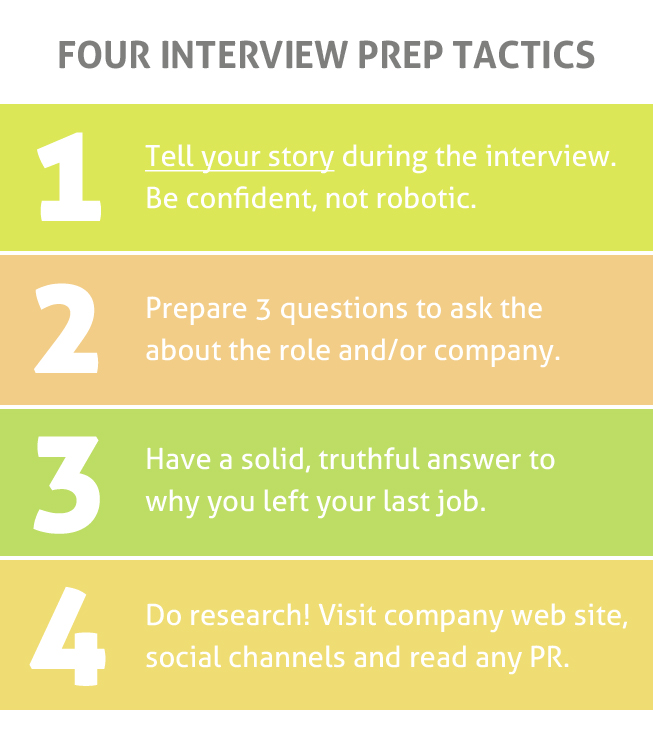
Here are more details on the Four Interview Prep Tactics to help you present your best self when meeting potential new employers:

1. Think about how you want to tell your story during the interview, but don’t be so overly rehearsed that it sounds like you’re trying out for a high school musical. The key word here is “story” and conveying yourself in a confident but relaxed manner – not robotically as though you’re reading bullet points from cue cards. Also look through your resume, or reflect on past positions, and come up with a short list of relatable projects that highlight your work experience and how well you’d be suited for the new role.

2. Have at least 3 follow up questions prepared for the interviewer at the end, when inevitably they will turn the tables and want to know if you have questions. This is nearly as important as the first part of the interview, because it shows you’ve thought about the position and the company that you hope to work for. As a freebie, a question I’ve always had success with is, “How big is the team I’d be joining?” or something along the lines of asking how the team is structured.

3. If you were laid off or let go from your last place of employment, have a solid answer ready because it will come up – and probably earlier in the conversation rather than later. Also it should go without saying, but be completely transparent about what happened. You want your answer to match was the HR department would say at your past company if the new employer was to call and ask.

4. Do your research! Scour the company website, read the “about” section and Google for any articles in the press. Also an audit of their social media channels can be helpful if you’re joining a B2C company that consumers would follow and comment on. Once you’ve done that, prepare a few key phrases you can weave into the conversation letting them know that you have looked over their digital assets/web presence. (Just try not to sound like a know-it-all… and if you’re a regular reader, you already know my views on smarty-pants-people.) In a nutshell, you’ll flush any bonus points down the drain if you come across as an outsider attempting to tell the interviewer what’s going on in their own house. You dig?

Now to the cautionary tale portion of the story… Which requires a little bit of backtracking, but I promise I’ll keep it brief.

In my previous job search expeditions, I’ve created mock proposals and taken them along on interviews as a special guest star in the “all about me” pitch. This was done in part to show my enthusiasm for the position but also because I’m a creative person with an imagination on overdrive and I wanted to showcase those skills as well. And with my last couple jobs, either it worked or it didn’t do any harm, because I ended up getting the position! Based on those successes, in my mind, this was the clincher; a home run idea and a way to absolutely differentiate myself from the herd of other candidates the employers were sorting through.

So why wouldn’t I continue this practice in the job search I’m going through now?

Fast forward to a couple months ago when a particular job opening came to my attention and after reading through the job description, I felt confident I could “rock it” and absolutely be able to execute on the tasks they’d laid out for the new hire to achieve. Also it’s important to note the position was one step up from where I’ve been in the past – but what’s the point of life if you’re not trying to better yourself and grow as a person? So I applied.

Not long after I was chosen to come in for a half-day interview process with some of the company’s executives, and in advance of that I carefully crafted what would be best described as a 30-60-90 day plan. Essentially it was a roadmap meant to convey, “If you hire me for this position, this is my game plan for completing the tasks and goals you’ve laid out in the job description.”

Once I’d completed the document I was bursting with pride. Not only was it full of great content and strategic planning, but I’d also artfully laid out in InDesign (a nod to my graphic design roots) so it looked very sharp and I thought I had the position in the bag. Who else was going to come in with a fully realized plan for the goals, large and small, included in the job description?

full house

This last part of the story, admittedly, is without a lot of specific details. But that’s only because I don’t have them to share, not because I’m holding back. (Believe me if I knew what went wrong I would tell you as I’m dying to know myself.) Anyway the post-plan epilogue is as follows… So I have the multi hour interview with the executives and share my 30-60-90 day plan. One exec seemed very impressed, while the other only seemed mildly interested and unfortunately it would seem the 2nd individual was the one calling the shots.

About a week after the interview, the 2nd individual called and said that while they liked me very much and thought I had a strong background, they were looking for someone more seasoned for the (higher level) position. Ouch.

It baffled me for weeks how my bright and sparkly 30-60-90 day plan had failed me. Surely no one else had come in as prepared… So where did the breakdown happen? Then the other day I was reading an article in which the writer said, “Some people think that anything offered for free is without value.” Hmm.

As I said earlier, with no specifics I can’t say for sure what happened in my situation and/or if the thought behind that quote was part of the reason the company decided to pass on me for the higher level role. But it certainly gave me cause to pause, which is why I’m sharing this insight with you here and now.

While it is most certainly beneficial to showcase your unique creativity and talents during an interview – at the same time, don’t give the farm away. Perhaps things would have ended differently for me if I’d only referenced the plan I had in mind versus bringing a hard copy blueprint to the interview. In that alternate reality I still could have showcased strategic forethought and creative insights, while at the same time refrained from shilling my wares on the corner for anyone to scamper off with.

For me that is the lesson learned – and I hope it’s helpful to you as well.