Chasing Bubbles: How to rein in unrealistic ideas and get the most out of brainstorming

You may not have blown many bubbles lately, but it’s hard to argue the delight and whimsy that comes from taking a deep breath and creating gleaming spheres of light that float on the breeze. Am I right? Such joy is also the case with unabashed brainstorming and letting your creative juices flow to develop new and exciting ideas.

Although everyone has their own take on how ideas should be sourced. For example, the fine folks at Fast Company can’t seem to make up their mind on whether “brainstorming” is a good idea or not.

Screenshot

Since 2011 they’ve reversed their decision 5 times by posting contradicting articles on the topic. But whether you call it brainstorming, team-building exercises, creative collaboration or whatever, there’s definitely a need to call one of these pow-wows every once in a while to get fresh ideas on the table.

However in this post I’m not going to focus on what you should call it, but instead outline some recommendations for structure, defining goals before you get started and how to rein in unrealistic ideas without being labeled “dream-crusher”. (Because no one wants that written on their name tag.)

Bubble Making 101

Before you start looking at the calendar and sending Outlook invites to the whole office, it’s important to have an outline of what you want to accomplish. Also make sure your boss (or whoever the key decision maker is) has signed off, because if you’re going left and they’re going right it’ll end up being a waste of everyone’s time.

Here’s a quick list of things you want to be sure you have locked down:

What’s the task at hand? Are you coming up with something new or revamping something already on the market?

What’s the goal at the end of the brainstorming? Do you want a list of 500 general ideas or 10 further developed concept ideas?

How much time do you have for the meeting? If this is an all-day affair, there’s definitely room to include some unstructured time, but if it’s only 2-3 hours you’ll need to make sure you have a firm agenda and stick to it.

Who’s driving the bus? It’s important to identify who will be running the session and that they keep everyone focused on the task at hand.

Beneath The Suds

Technically the definition of brainstorming is throwing any kind-of idea out there to see if it sticks, but it’s also important to be realistic. If there are things you know the company will never go for, set up those guardrails early and enforce them. Otherwise you’re devoting time and resources to develop ideas that will never see the light of day, and much like our glistening bubble friends, they may look pretty but they don’t last long.

Stay on TaskIn addition to that, be wary of good ideas that get blown up by unnecessary or unrealistic add-ons. (If a small bubble is shiny, then a bigger bubble must be even shinier!) Whoa there. This goes back to what was said in the beginning: know your goals for the session and what’s really possible to execute.

From personal experience, I’ve seen lengthy conversations develop over the discussion of completely over the top, high-cost and potentially unmanageable marketing ideas. How is that a good use of anyone’s time? That’s why it’s imperative to stay on task, with one eye on the goal and the other on the agenda.

Runaway Bubbles
You might be thinking at this point, why do we keep talking about bubbles? (Or maybe, “I need to stop and pick up some Calgon…” Who knows ☺) But for the purposes of this post, the idea of chasing a bubble seemed like a good analogy to illustrate how quickly ideas can be developed, overblown and then quickly fade away. So in this last section, let’s quickly talk about reining in bad ideas before they get out of control.

pigWe covered some of this in the paragraphs above, but that’s if you’re able to put the kibosh on something before it even gets started. But what if something is already in play? Maybe the purpose of your brainstorm session is to correct a bad idea that’s already been executed. In which case it’s important to proceed thoughtfully – otherwise you risk putting lipstick on a pig – and in our case we’re trying to save Wilbur from a Mary Kay makeover.

Bad ideas can get started in a number of ways, but a likely culprit is someone making a decision for an area of the business that they shouldn’t be. For example: accounting making a decision for marketing or vice versa. If that’s the case, don’t be afraid to shut it down. Accounting shouldn’t be dictating a marketing campaign just like marketing isn’t telling them how to pay invoices.

Of course it’s always better to play nice in the office and across departments, so if this is the situation you’re in, the best way to unravel the knot is to open up a dialog.


“What’s the total cost?”

“What’s the expected ROI?

“Does this speak to our demographic?

“Does this bring us new customers?”

“How long has the program been running and what have we gained – or lost?”

“Does this align with our brand?”

These will vary depending on the program and your business model, but you get the idea behind the questioning. It’s to identify: “Why are we doing this” and “What are we getting out of it?” Oh and remember to let the bubbles float on by… there’s no ROI if you catch one.

Welcome To The Jungle: My customer service experience with Amazon.com

The subject matter for this post is a little out of the norm for the blog, but having good customer service is certainly a cornerstone to running and maintaining a successful business. So as marketers, if you’re focusing on driving traffic to your business, you’d better be sure your house is on order on all sides. Customer service being at, or near, the top of that list.

What brought this up was the experience I had with Amazon recently when trying to return an item. Which you’d think would be a no brainer, except I seemed to have stumbled upon their Achilles’ heel because what I needed to return was larger than a hardcover edition of Lee Child’s latest thriller.

It’s actually a hybrid trainer; meaning it’s half elliptical and half recumbent bike and truth be told, I’d love to be able to use it and didn’t really want to return it. However after running into some issues with key pieces of the equipment not coming together as they are supposed to and receiving ZERO help from Proform customer service, I decided to join a gym and return it. (Extinguishing my dream is home workouts and multitasking during weekend TV binge-watching.)

Welcome to the Jungle

Welcome To The Jungle

What happened next is hard to describe concisely, but I’ve tried to whittle it down to the main plot points of the story, which began with a simple “chat” session between myself and customer service. On this chat I explained the issues with the equipment, the lack of support from Proform and that I was ready to give up and just return the darn thing. The person on the other end was sympathetic and said they would begin the return process, all I needed to do was take apart the equipment and pack it up, they would provide a prepaid UPS label and schedule the pick-up.

All of that sounded simple enough, until reality set in and I realized a couple things: #1 The original box and packaging had been recycled and was gone. But more importantly, the box had been the size of small refrigerator. Where in the world was I going to find something that size to hold everything? #2 This thing is the size of a smart car and extremely heavy. When it first arrived I had to open the box where it had been left and take it in piece by piece. So how exactly was this repackaging going to happen… in my front yard? That’s classy.

I reached out to Amazon again, explained my story for the 2nd time and included the aforementioned details that had occurred to me after the initial call. This new person said Amazon has a “large item returns” department and he would pass along my information to them – and since it was the weekend so he said they would call me on Monday.

Well no one ever called, however someone did schedule a pick-up with UPS and they came to my house twice trying to collect the equipment. I had to call UPS, apologize for the miscommunication and cancel the pick-up. (Frustration was beginning to build.)

The following Tuesday, I called Amazon and explained for the 3rd time what was going on. This person was less sympathetic, told me my item did NOT qualify as a large item return (read: baffling) and brought back the original course of action: pack it yourself and we’ll give you a label. (Frustration is now rising from defcon level 5 or 4.)

KermitIt was clear I wasn’t going to get anywhere with this person so I asked to speak to a manager, she got on the phone and recanted my story for the 4th time. Her solution was even better than any I had heard so far… she wanted to know if I could just take the equipment to UPS and have them pack it up? Yes, you read that right. In the stunned silence that followed, I fought back the urge to tell her how completely asinine that idea was and to ask if she knew the difference between returning a mixing bowl and returning an elliptical machine? I finally responded and said that was not a viable option and wanted to get back why the mysterious black-ops large item return team couldn’t help me?

But you could tell we were getting close to passing her level of influence, so she told me she’d reach out to them and call me back. A few hours later she did call back (twice actually) but unfortunately I was not in a place to take calls and planned to get back to her shortly. However when I checked the two messages she left on voicemail, neither one included a call back number. Neither one. She did say in the messages that the large item team had agreed to help and that I needed to call them back to set it up. Which would have been fine and dandy if I’d had a phone number to reach them. (Defcon level 4 moving to level 3.)

Level 1-5Following these completely useless voicemails, I emailed Amazon and told the whole story for the 5th time. What I got in response was unbelievable.

The person who emailed managed to simultaneously apologize while also rescinding the offer of large item team helping. He then trotted out the old “pack it yourself” routine and signed off with an insulting offer to apply a $10 credit on my account for my troubles. It was at this point we completely skipped over level 2 and landed firmly at Defcon 1. Man your battle stations people.

After giving myself a chance to calm down, I called Amazon yet again. When I was connected with a customer service agent I started the conversation as follows, “I just want to put this disclaimer out on the table; I realize what’s been going on is not your fault and I am certainly not blaming you. But I want you to know that I am beyond frustrated by what’s happened over the last few days.” The woman thanked me for my candor and said she wanted to help.

So for the 6th and final time, I told the whole sordid story. After hearing everything I had to say, reviewing the notes on my account and speaking to her manager she responded with this, “Well I have good news and bad news. The bad news is I can’t help you return the item, but the good news is we’re going to issue a full refund.”

Wow. I didn’t see coming.

And while I’m extremely relieved the situation has been resolved and grateful they were willing to “make it right”, it leads to the bigger issue I’d like to address. Why did it take 6 different encounters to find someone competent who could actually help? Although I think everyone can agree this situation is not limited to Amazon, but applies to all companies with customer service departments; it’s all in who you talk to. But why? Don’t they all go through the same training and isn’t there testing to pass the training??

Let’s also call my situation what it really is… making it right is just the nice way of saying they paid me off. And sure, a couple hundred dollars isn’t even a blip on the radar for a company of their size. But if they keep doing that because folks are continually subjected to their gauntlet of ineptitude then surely it will start to affect them at some point.

Looking at the bigger picture; investing in better training, on-going training and spot checks (aka secret shoppers) would help shore up these gaps. In the meantime perhaps they should discontinue including, “Earth’s Most Customer-Centric Company” in their email signatures, as I don’t think they’re there just yet.

SMX East 2014 Conference Recap: My takeaways from a trip to NYC with some SEOs

Back in September I attended SMX East 2014 in New York City for the first time and although I’ve been to other SEO conferences, they were never in “The Big Apple”, so expectations were high. Here’s my post recapping the event and venue, please share in the comments any of your takeaways if you attended as well.

The venue?
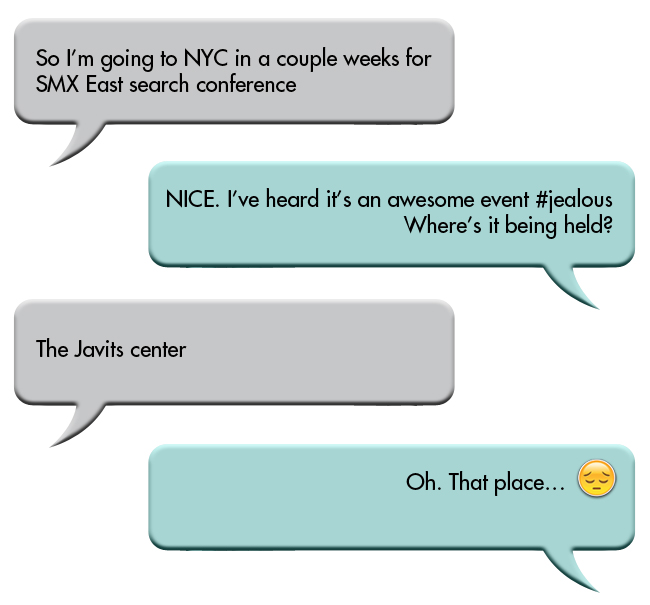
Weeks before the conference started, if SMX came up with friends or colleagues I kept having the same strange conversation again and again…

Javits

So by the time Day 1 of the conference arrived, I had mixed feelings (to say the least) and as we got to the end of 17th and were waiting at the crosswalk, the much ballihooed Javits Center was all you could see across the street. A bleak mountain of glass and steel that could probably double as Superman’s Fortress of Solitude should he ever get tired of going to the north pole. But it is a conference center after all, so how much architectural fanfare should be expected?

Once inside we went through the check in process, got our badges and were then pointed to a swag table where we received a black cross-body backpack full of vendor sales material. The backpack was cool and the spam inside was to be expected, but the problem was that now we’re here for the whole day with yet another thing to carry around. I myself already had a laptop bag and a purse… and now backpack makes 3. Awesome. There were also no lockers or coat check areas around so we were stuck with quite a bit of “luggage” for the duration.

But I digress and will just say it would have been great if they’d handed out the swag at the END of Day 1 instead of the beginning. Rant over. ☺

Hope you weren’t expecting a lot of personal space
Just to quickly touch on the meeting rooms for the panel discussions, all I say is that if you’re familiar with the ever narrowing personal space available on a flight in coach then you would have been right at home here.

It was unbelievably compacted in all of rooms and especially for the really popular sessions, we were like refugees packed into a grass hut. If you didn’t get there early, folks were grabbing spots on the floor, in the back (i.e. standing room only) or wherever they could find room to squeeze in. And not that anyone asked for my opinion, but if there was a way to RSVP for sessions in advance, that would helped manage the size of the crowd or move the really popular sessions to larger rooms. Just a thought.

Beware the badge police
The last slightly ranty thing I’d like to mention was the overzealous badge monitoring done by the event staff. I can’t say whether they work for SMX or Javits (and who knows maybe they were trained to be militant?) but they were everywhere and absolutely let you know where you stood in the pecking order of access.

My first encounter was after my colleague and I had gotten past the check in area and were down in the hall being used for SMX. We saw a handful of round tables just off the main walkway and headed over to stop for a minute and get organized, but no sooner had we walked up to a table but an attendant rushed over, demanded to see our badges, and immediately told us we had to leave that area. They said it was VIP only and that we could go to the open area at the end of the hall. Okay, that’s fine, but it wasn’t like we were trying to sneak into The Oscars. There was no signage stating it was a special area, none of the tables were full and we weren’t planning to camp out there as the first session was about to begin on 5-10 mins. So we left and went to the other area (where we were badge checked again before entering!) and all in all it really wasn’t the best “welcome” to kick off Day 1.

Now for the main event
It was a jam-packed three days at SMX East 2014 and each day had four distinct sessions (2 morning, 2 afternoon) with 3-5 panels to choose from. So it wasn’t a question of finding a session you liked, it was about making hard choices on which one to attend! I stayed more on in the SEO fundamentals, PCC, mobile and content tracks – but there were plenty others focused on SEM, social, link building and more.

Mobile Recap
There was a good focus on intent for search as it relates to mobile and how ranking on mobile & desktop are different because of this. Which is of course true as the ‘need state’ of the user is inferred to be different (and rightly so) as a mobile searcher needs something right now, versus desktop searcher is possibly planning to do something later.

Example: searching for “bank” on desktop vs. mobile

On desktop, I might be looking for investment advice, 401k information, loans, savings accounts – you name it. However on mobile, most likely I need some cash and just want the closest ATM. Therefore the search results delivered to me so me take that into account and serve up what is most likely my ‘need state’ based on device type.

It seems like Google is continuing to reward sites designed with this ‘need state’ in mind and as of Nov 18th Search Engine Land announced an experiment giving Google designated mobile friendly sites a better ranking in mobile SERP.

Here are few other fun-facts about mobile from the session that day:

Mobile is outpacing desktop x10
• 23% of organic search are from smartphones
• 62% of keywords have different ranks

Mobile keyword intent from data
• stock of product available nearby
• top X products/services
• reviews (especially locally/socially)
• video and interactions w/products
• click to call and locations nearby

Deconstructing Pigeon (no, it’s not a French haute cuisine dish)
On Day 2, I attended a great session that demystified some of what had gone down with the latest Pigeon update and here are a couple highlights from my notes:

• Google is recognizing generic searches (boats for sale) as branded searches
• Google is using keywords in reviews (yours and competitors) to generate search results
• Google also narrowed the search radius in suburban areas (meaning business owners with locations in small towns were hit hardest)

And while there were definitely some negative effects from the Pigeon update, here’s what you need to know to make sure you stay on the dean’s list.

Pigeon-Winners

Also the good folks over at Moz had some sage advice to share and provided a handy checklist I think everyone should take a look at and will find value from.

However as we all know, it’s been bird battle cage match over the last couple of months with updates, roll back and changes are happening faster than you can say “happy feet” so who really knows how this is going to net out? For the latest Penguin update (as of 12/5/14), it’s summed up nicely here from our friends at SEO Round Table.

Q&A Everyday: Being a “yes-man” means you’re not innovating and you’re not adding any value to the conversation

Throughout our work lives there will be ups and downs, but invariably there will also be routine tasks or process that you follow on a daily, weekly, monthly or annual basis. And while there’s nothing wrong with a little repetition down a well-beaten path – where’s the adventure or innovation in that?

So in this post, we’re going to throw out the map (if you will) and see what happens when we question things and look for solutions in new ways.

Don’t just go with the flow

As mentioned in the title, if you’re not innovating then you’re not adding value. Every hear the phrase, “it’s so easy even a monkey could do it.” Yeah, it’s like that. But you and I both know we’re smarter than those hairy banana-peelers down at the zoo… so let’s start acting like it. First step: Question Everything!

Although I do say that with a little of asterisk disclaimer overhead – and while I don’t want to completely derail from the topic at hand – I’ll just say this: Question everything, but be smart about it.

I think we’ve all been in a meeting where that certain someone has to pick apart every little detail down to the atom that created it. Don’t be that person.

Question Everything

There is a big difference between annoying your co-workers and colleagues to the point of them needing midday cocktails versus being the one at the table interested in smart innovating. So please remember the asterisk every time you hear me say “question everything”.

Okay now back to the main event. Hopefully as this idea has started to roll around in your head there are things you’ve started to identify as “the good ol’ ways”. Those are the things we’re after:
– processes for weekly/monthly annual reports that haven’t changed in years
– or ways information is presented to/from vendors that haven’t ever had an upgrade

And probably one of the bigger black-holes in all of this are the annual expenditures that just “renew” magically without anyone actually asking, “Why are we paying $___ for ___?”

Take a marketing budget for example… unless Don Draper is leading your creative time, any money earmarked for “traditional media” aka billboards, direct mail, print ads, etc. needs to be seriously reconsidered and allocated into the digital ages of web, mobile, social and search. (Sorry Peggy.)

The challenges of doing something different.

Well the good news is that everyone loves change and embraces it wholeheartedly. So getting your company to try something completely new should be no problem. (“Oh hello Irony, I didn’t see you come in…”)

Obviously that is complete fiction, although it would be pretty awesome if it was true, but the reality is you’ll most likely have a bumpy road ahead if you try to detour your workmates and/or senior leaders away from the comfortable routine they’re used to. But it’s important to try, and if you feel yourself in need of some inspiration, remember this quote:

We've always done it this way

Just keep reminding yourself of that – and in the meantime – here are two additional tips to help get your “new ways of doing things” off the ground.

Create a Plan for a Test Case
People are much more open to change when they thing they can get out of it. “Money Back Guarantee” or “Free Trial Offer” – you know the drill. So follow suit and create a plan for a test/demo/beta (whatever floats your boat) and frame up your idea more as a “What if we…?” to get more buy-in.

Find an Ally
Just as friends are important in daily life, allies are important in business. Find someone (there has to be some body) who will support your idea. And (bonus!) once you tell them about it, they may have ideas for improvement. So now, not only do you have better innovative solution but your ally is also more invested because now they have a stake it in. Boom.

So let’s wrap this up and get you out there innovating… just remember the following:
– Question Everything*
– (*Don’t be annoying)
– Change is Hard
– Develop a Test-Case
– Find an Ally

Good Luck and Happy Innovating!

Check Your Watch: The challenges of executing a marketing promotion across different time zones

Most everyone enjoys watching sports as a pastime and why not? Seeing a group of people chase, throw, catch, hit or kick a ball around is generally considered a good time. But what happens when all this action is going on across different time zones? Where do you set up a home base – or should you? In this post we’ll look at how to tackle (sorry, had to use at least one sports puns) marketing a sporting event promotion successfully from sea to shining sea.

One of the biggest mistakes I’ve seen is when the marketing team decides that wherever they are is the home base, so everything is planned and designed through that lens. Which is an understandable point of view, but let’s try to step back a bit and consider a few things before planting our flag in Mt. It’s All About Me.

Also for the purposes of this exercise, let’s say the Marketing Team is located in Portland, OR so we have a point of reference. But feel free to ad-libs style the questions below and swap in your city so it’s a more useful evaluation tool.

• Is Portland also where there’s a large customer base? Where the corporate office is located does not always equal a fruitful customer base so be careful with this one.
•• Ask for sales numbers at all of your companies locations (if you have brick and mortar storefronts) or pull analytics from social media and web to see if there are any concentration areas where a lot of your business is coming from. In the end I would still not recommend picking one singular place as a focal point, but if you do find there are some ‘hot spots’ across the country maybe consider adding something extra to the promotion in those areas.

usa50

• Are you working with an agency? If yes, then make sure you ask them to consider point #1. An agency could be located anywhere (near or far) from the corporate office much less any customer ‘hot spots’. Be sure you ask them about this and formulate a plan that will bring about the most success for the campaign, regardless of where the marketers are located.

• Getting back to the team in Portland (who’s also be rocking the Pacific Time Zone) keep in mind that you should be publicizing the times of the events in the most common way they are shared. Which not necessarily what makes sense for your own geography.
•• For example: NFL games. If you’re working on anything football related, you’ll notice that every game on the schedules is posted in Eastern Time. So if you’re going to create any collateral, I recommend doing the same. It’s one consistent message for your customers and if you provide any links back to NFL.com in any of your social campaigning, your customers will see information consistent with what you have shared with them regarding your promotion.

football
Now that we’ve covered all of that, and still using football as an example, another big miss for brick and mortar folks is navigating the ups and downs of opening early or staying open late. Because as much as we’d all like to have one national campaign, let’s be real, that’s not going to happen. So keep these things on your radar:

• To use Sunday Football as an example, the first games start at 1pm Eastern which is 10am Pacific. You think, great! But wait.
•• What time do your West Coast locations open normally on Sundays? If it’s not before 10am, can they?
•• Do you have the staffing and budget to support those extra hours?
•• Also how will you let your customers know that you are opening early so you get the business to support and validate opening early.

• Now let’s talk about the last game on Sunday’s which starts at 8:30pm Eastern, 5:30pm Pacific. This one is great for West but for anyone in the East, those games can go on until 11pm or later, so let’s ask a variation of the same questions from above.
•• Do you normally stay open that late? Do you want to?
•• Do you have the staff or budget in place to support it?
•• And most importantly, does your promotion even make sense for a game that runs late into a Sunday evening. For most of America that’s a “school night” and we all have to get up and go to work the next day. Does what you’re asking your customers to do justify them staying out later then they normally would? What’s the value proposition and reason for them to give up on some shut-eye to stay engaged with your brand?

Overall the biggest take-away is this: plan strategically and thoughtfully.

Think about where your customers are, what they want and what makes the most sense for them dependant upon day of the week, time of day and what your promotion is offering. If it makes sense, which I think it does, plot out a marketing plan per time zone.

And don’t be afraid to ask your customers for their feedback too! We all know how people love to share their opinion (yay interwebs) so ask them. The answers might surprise you and offer up alternatives or add-on’s to the promotion that you hadn’t considered before.

Hope this has been helpful and please share any of your own marketing experiences in the comments! #GameOn


Thank you worldatlas.com for the USA map outline!

3 Tips For Creating A Winning Presentation

Winning PresentationMaybe it’s because I come from a graphic design background, but the importance of having a solid deck (powerpoint presentation) is not lost on me. And when I say ‘solid’, I’m not talking about all of the fancy facts and figures procured from the insights or finance department.

I’m talking about the basics like: fonts, page layout and presentation size. It’s unbelievable how many presentations I’ve seen from agencies, sales people, etc. that forget (or just don’t know) these 3 basic rules.

1. Fonts
While it may be tempting to put on your creative-hat and hope to impress your audience with the latest font you downloaded, keep in mind that you are the one that downloaded it – not the rest of the world. So unless you plan on attaching a font suitcase to your presentation and asking them to download and install it, stay away from adding pieces of flair to your deck.

Stick with the classics, also known as systems fonts or universal fonts, that most people would have on their computer so when they open your presentation it looks as you intended on not like gobbltyguck.

Fonts

So yeah, that will happen. However you can get around the font neutering by creating your presentation with as many bells & whistles and you can stuff into it, then saving as a PDF and sending that way. Word of caution though; From personal experience I’ve tried this route and you would have thought I’d sent the recipient a bouquet of dead roses (i.e. They did not like the PDF file.)

I think there’s something familiar and standardized about good ol’ PPT files which makes people feel more at ease because that’s what they are used to getting. Also (and I’ll touch more on this when we get into file size) you never know who’s going to get their hands on the file, so my advice would be to keep it simple and stick to the basics.

2. Page Layout
This step is tricky because sometimes you don’t know what the final outcome of the presentation will be… is it going to be printed, displayed during a webex, both? I actually worked on a deck once that was going to be projected onto a movie theater screen, which required some additional planning to say the least! On that size screen, you have to actually think of your deck as a movie and keep in mind where the eye goes (and what it can easily see) during a film. I took the stance of keeping everything at least an inch or two away from all borders and trying to centralize all of the text + images. That would make it easy for anyone, regardless of their seat in the theater, to see the content.

Anyway for all of those times when you don’t have to worry about a cineplex-friendly layout, here are a couple tips:

• Try to get as much info as you can in advance about where this presentation is going to go and how it will be used. If you know it will be printed, try to stick with standard sizes (letter and legal). Absolute last resort would be tabloid size (11×17) unless for whatever reason that is deemed reasonable. (Another personal experience tid-bit here: I received an agency presentation once in tabloid size and 30+ pages [goodbye rain forest]. Not only was it a nightmare to get printed for myself and the team, but carrying the thing around from meeting to meeting was like having a toddler on my hip. So if possible stay away from the dreaded tabloid size!)

• If it’s going to be displayed on a screen and not printed, try to find out what size. For example: movie theater or boardroom. This makes a difference. But in either case you want to use the 16:9 ratio setting which will work on most flatscreen tv’s and newer laptops.

3. Email-able Presentation Size
I think we’ve all had the vendor/boss/coworker who’s emailed over a presentation and said “can you take a look at this?” only to click on the attachment and realize it’s 20mb or more. (Really?) Not only does this fill-up your inbox but if you’re expected to forward it onto someone else, now you’ve got two copies of this beast on your email and sending/receiving will absolutely slow you down if you’re traveling and on wifi. No bueno.

So what to do? Well if it’s your presentation, it’s time to take it to fat camp:

• Make sure all of the photos you’ve inserted are optimized for web. If you’re not sure what this means, ask a friend who has photoshop and tell them you need 72 dpi JPG images stat!

• Be careful about embedding videos. Yes, it’s cool and all when you don’t have to navigate out of a presentation to show a video but I recommend following the Spandex Rule here. (Just because you can, doesn’t mean you should. Know what I mean?) In this case, embedding a video file directly can take a simple presentation from the 20mb range up to the 200mb range… (“I love it when you call me Big Poppa”) My advice, pull up the videos on You Tube and leave that tab open on your browser. If you need to hop over during the presentation it takes about 2 seconds and I don’t think anyone is going to fault you for that.

• And to wrap up the point I made earlier, you never know who’s going to get this presentation so keep things svelte. The worst thing would be having a CEO/boss/potential client receive your big fat deck, decide it’s taking to long and they’ll “download it later”. Which means… the Monday after never.

Definition Refresh for Open Work Space: The pro’s and con’s of an open work environment

At every job you go to there’s the expectation of having a desk, computer, phone, post-it’s and sometimes even a red stapler if you’re lucky. But how the desk area is configured depends on the company… sometimes you get a full-on office, sometimes a cubby and sometimes you’re out in a ‘bullpen’ type area known as the open work space.

In all of these scenarios there are obviously pro’s and con’s, but in my humble opinion the open work space area carries with it the most con’s as you truly don’t ever get to unplug from your coworkers. Now depending on what your job is and what you’re being asked to produce, this might not be a bad thing, but I have to say I think most people need a little “me time” even during their work day.

But besides needed/wanting to unplug there is one other big negative to the open work space… the chatty Cathy. (You know who I’m talking about.) The coworker that doesn’t know when to stop talking and over-sharing. I think we’ve all know someone like this and it truly can create a problem within a team because productivity stops while rambling Rita regales all of us with her stories from the weekend.

However being that you work in close proximity and have to see this person every day, it’s not really appropriate to say, “I don’t care about; your significant other, your pets, your vacation plans, your family problems, the new restaurant you just tried or what class at the gym you’re going to take this week. Okay??”

So what can you say? Well first off, my advice is to employ the stray cat analogy of “don’t feed it”. If you don’t pay attention to this person and engage, at some point they will realize they don’t have an audience and (hopefully) put it on mute.

If that doesn’t work and/or you really do have a friendship with this person, try saying, “You know I’d really love to hear this story but could we talk about it over lunch?” Again hopefully you’re not dealing with someone who is so daft they can’t pick up on hints and after doing this a few times will realize that you are trying to focus on work during work hours (you know, the whole reason you’re there) and that chit-chat time is for coffee break or lunch time.

Now onto the good things about open work spaces… to the pro’s list!

On the upside, being able to quickly gather the troops and have an informal meeting is by far the biggest plus to having your whole team within arms reach. I would say this is especially helpful for social media teams who need to react to news in real-time and if you can do a quick chair swivel to get feedback and/or approval for the perfect tweet. Bonus!

Another positive side-effect is being able to hear other conversations going on that might not have included you, but that you need to be apart of! Example: brand manager is talking to graphic designer about collateral for a new campaign. Let’s say you are the web master and overhear this, it’s the perfect opportunity to say, “Are you going to include the website on the collateral? If so we can add a CTA to the homepage that correlates with the messaging on the collateral.” Boom! That’s a win-win and now the campaign completes a full circle from static piece to website.


So now I want to hear from you – leave a comment and let me know what experiences you’ve had with open work spaces (good or bad).

Happy typing!